Destination
Bhutan
Land of the Thunder Dragon
Bhutan is the only country in the world that measures its success in Gross National Happiness. It is a place where development is deliberately slow, where ancient monasteries still govern daily life, and where the mountains are so sacred they have never been climbed.
Entering Bhutan feels like stepping into a different era, not because it's backward, but because it has chosen carefully what to keep and what to leave out. Mobile phones exist. Traffic lights mostly don't. The capital Thimphu has no red light signals by choice.
The Paro valley, where your flight lands, is one of the most dramatic arrivals in aviation. The runway sits in a narrow gorge flanked by terraced fields and forested ridges. You descend between peaks and land on a strip of flat earth that seems impossible until you're on it.
Bhutan requires a minimum daily spend for international tourists. This isn't a barrier, it's a filter. The country has chosen depth over volume, and every journey here reflects that choice.
Highlights
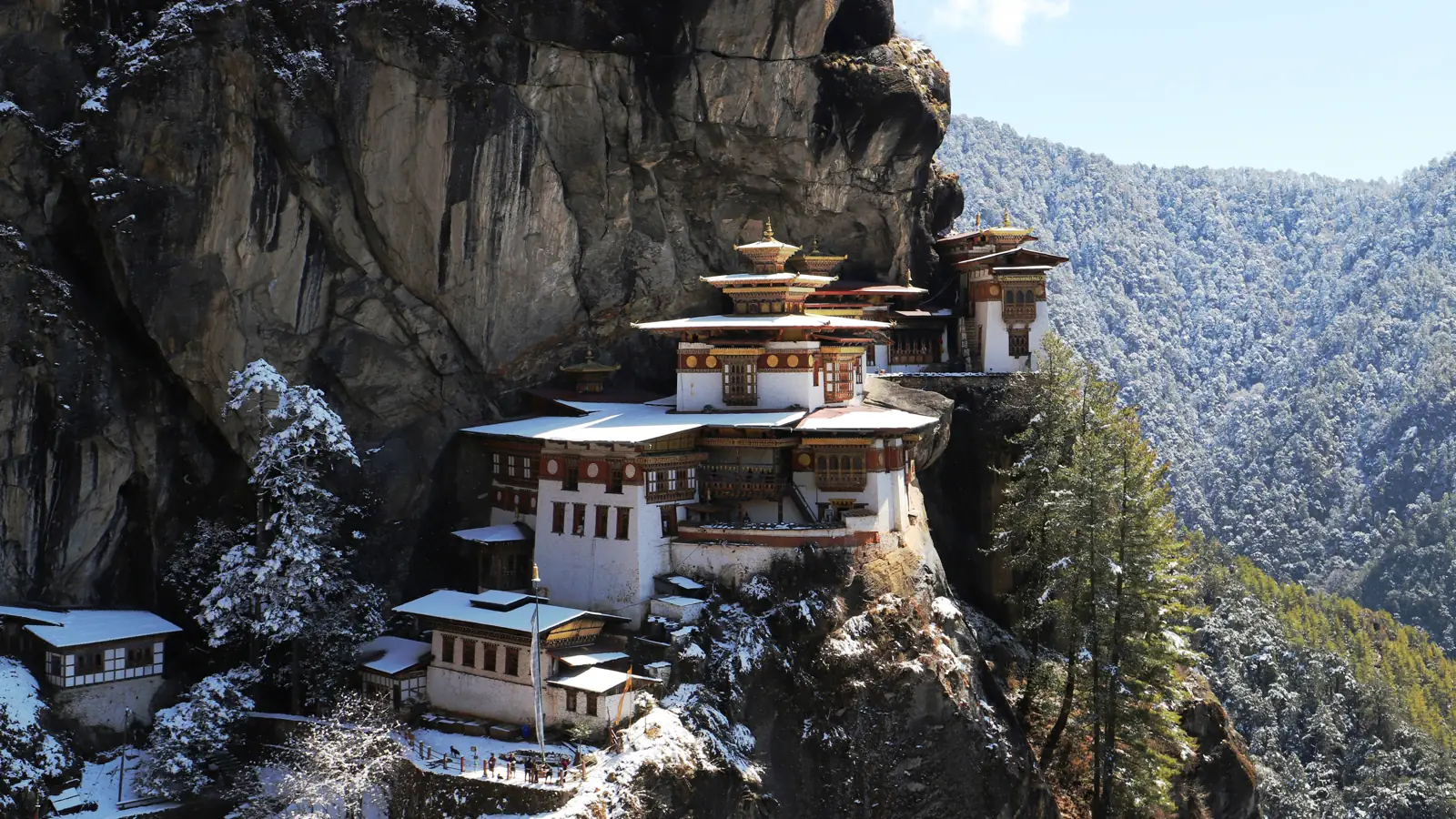
- —Tiger's Nest Monastery (Paro Taktsang) hike
- —Punakha Dzong, the most beautiful fortress in the Himalayas
- —Traditional farmhouse stays in Phobjikha valley
- —Black-necked crane festival (November)
- —Archery, Bhutan's national sport, played everywhere
- —Hot stone baths in the traditional Bhutanese way
Quick Facts
- Capital
- Thimphu
- Best For
- Monasteries, happiness, hiking
- Altitude
- 600m – 7,570m
- Currency
- Ngultrum (pegged to INR)
- Entry
- Visa required, we handle the process
- From Bangalore
- ~2h flight to Paro
Bhutan is beautiful year-round but most rewarding in spring and autumn. Spring brings rhododendrons in bloom and clear mountain views. Autumn offers crisp air, harvest festivals, and the best trekking conditions.
Spring
March – May
Rhododendrons coat the hillsides in red and pink. Tiger's Nest trail is at its most beautiful. Festival season begins. Clear views of the high peaks.
Autumn
September – November
Post-monsoon clarity. The Black-necked Crane Festival in November draws the cranes to Phobjikha valley and the valleys fill with the sounds of ritual. Harvest underway. Best trekking season.
Winter
December – February
Cold at altitude but lower valleys remain mild. Far fewer tourists. Phobjikha valley hosts the cranes. A quieter, more contemplative Bhutan.
Monsoon
June – August
Heavy rains. Leeches on the trails. Mountain views obscured. We don't recommend this period for most travelers.
Experiences
Tiger's Nest Hike
The most iconic hike in Bhutan, a 3-hour climb to a monastery perched on a cliff face at 3,120m. We start at dawn before the day-trippers arrive. At the top you hear the prayer wheels turning and the butter lamps crackling and nothing else for as far as the valley goes.
Punakha Dzong
Built at the confluence of two rivers in 1637, Punakha Dzong is the most spectacular fortress in the Himalayas. We visit in the late afternoon when the light turns everything gold.
Farmhouse Stays
Sleep in a traditional Bhutanese farmhouse in the Phobjikha valley. Join the family for meals, walk the valley, and watch the black-necked cranes come in at dusk.
Hot Stone Bath
A traditional Bhutanese hot stone bath (dotsho) uses river stones heated over fire to warm the water. Combined with medicinal herbs, it's one of the most restorative experiences in the Himalayas.
Archery Villages
Archery is played with genuine passion across Bhutan. Watch a village match, or join one, and understand something about Bhutanese culture that no monastery can teach you.
Thimphu Market
The weekend market in Thimphu is where Bhutan's farmers, monks, students, and bureaucrats all mingle. A quiet hour here tells you more about the country than any guided tour.
Bhutan: The Happiness Route
Six days moving through Paro, Thimphu, and Punakha, the three valleys that hold most of Bhutan's history and all of its heart. Tiger's Nest, a dzong at golden hour, a farmhouse stay, and enough empty time to actually feel something.
Day by Day
Arrival in Paro
Land at Paro airport, one of the most dramatic arrivals in the world. Settle in, acclimatise, evening walk through the old town.
- ·Paro airport arrival
- ·Check-in to heritage guesthouse
- ·Evening walk in Paro town
- ·Welcome dinner
Tiger's Nest
Early morning start for the hike to Paro Taktsang. We go before the crowds. Three hours up, time at the monastery, three hours down.
- ·Dawn start for Tiger's Nest hike
- ·Monastery visit at the top
- ·Packed lunch on the trail
- ·Afternoon at leisure
Drive to Thimphu
Morning drive to the capital. Visit the weekend market, the National Memorial Chorten, and the dzong at dusk.
- ·Drive to Thimphu
- ·Weekend market visit
- ·National Memorial Chorten
- ·Tashichho Dzong at sunset
Punakha
Drive over the Dochu La pass (3,100m) with views of the Himalayan range on clear days. Afternoon at Punakha Dzong.
- ·Dochu La mountain pass
- ·108 chortens walk
- ·Punakha Dzong visit
- ·Farmhouse dinner
Phobjikha Valley
Drive to the glacial Phobjikha valley. Hot stone bath in the afternoon. Walk among the black-necked cranes at dusk.
- ·Phobjikha valley walk
- ·Gangteng Monastery visit
- ·Traditional hot stone bath
- ·Crane watching at dusk
Departure
Morning at leisure in Paro. A slow breakfast, a final walk, and your flight home carrying something you can't quite name.
- ·Final morning in Paro
- ·Last-minute market stop
- ·Airport drop-off
6 Days / 5 Nights
₹85,000 – ₹1,10,000 per person
4–8 people
March–May, September–November
What's Included
- ✓Sustainable Development Fee (SDF) included
- ✓All accommodation (heritage guesthouses)
- ✓All meals (traditional Bhutanese cuisine)
- ✓Licensed Bhutanese guide throughout
- ✓All transportation within Bhutan
- ✓Visa processing assistance
- ✓All entry fees and experiences
No commitment. We'll answer your questions first.
From people who've traveled Bhutan with us
“Every moment felt intentional. Nothing wasted. Nothing rushed. Just perfect pacing and genuine connection.”
Rahul, Mumbai
Bhutan Journey, October 2023
“Tiger's Nest at dawn with no one else around. That's the ClearEast difference: they know when to go.”
Meera, Pune
Bhutan Journey, April 2024
Common Questions
Planning a Bhutan Trip
What is the best time to visit Bhutan?
October and November are widely considered the finest months for a Bhutan trip: clear Himalayan skies, comfortable temperatures, and the vibrant Thimphu and Jakar tshechu festivals. Spring, from March to May, is the second great window, when rhododendrons and jacaranda bloom across the valleys. The monsoon from June to August brings cloud and rain, while winter offers crisp, quiet, crowd-free days if you do not mind the cold.
Do Indians need a visa or permit for Bhutan?
Indian nationals do not need a visa for Bhutan, but you do need an entry permit and must pay the Sustainable Development Fee, currently ₹1,200 per person per night for Indian travellers. You will need a valid passport or Voter ID. ClearEast Trip arranges your permits, the SDF payment, and the route permits for Punakha and beyond, so you arrive with the paperwork already handled.
How many days are enough for a Bhutan trip?
Five to seven nights is the sweet spot for a first Bhutan journey. That gives you time for Paro and the climb to Tiger's Nest, the capital Thimphu, the dramatic drive over Dochula Pass to Punakha and its riverside dzong, without rushing. Slow travel is the whole point in Bhutan; an extra day or two lets you experience a farmhouse stay, a hot stone bath, or a quiet monastery most tours skip.
How difficult is the hike to Tiger's Nest?
The hike to Tiger's Nest, or Paro Taktsang, is a steady uphill climb of around two to three hours each way, gaining roughly 1,700 feet to reach the monastery at 10,240 feet. It is challenging but achievable for anyone of reasonable fitness who takes it slowly. We start early to beat the crowds and the heat, ponies are available for the first stretch, and the view at the top is unforgettable.
How much does a Bhutan trip from India cost?
A Bhutan journey is priced per person and varies with group size, season, and trip length. The cost includes the Sustainable Development Fee, all permits, accommodation, daily meals as per the Bhutan tourism norm, an experienced licensed guide, and private transport. Our small groups of four to eight keep the experience personal while keeping per-head costs fair. Message us on WhatsApp with your dates for a clear, all-inclusive quote.
Ready to plan?
Most journeys begin with a 10-minute conversation.
Tell us where you want to go, when, and who is coming. We handle everything from there.
We usually respond within a few hours.