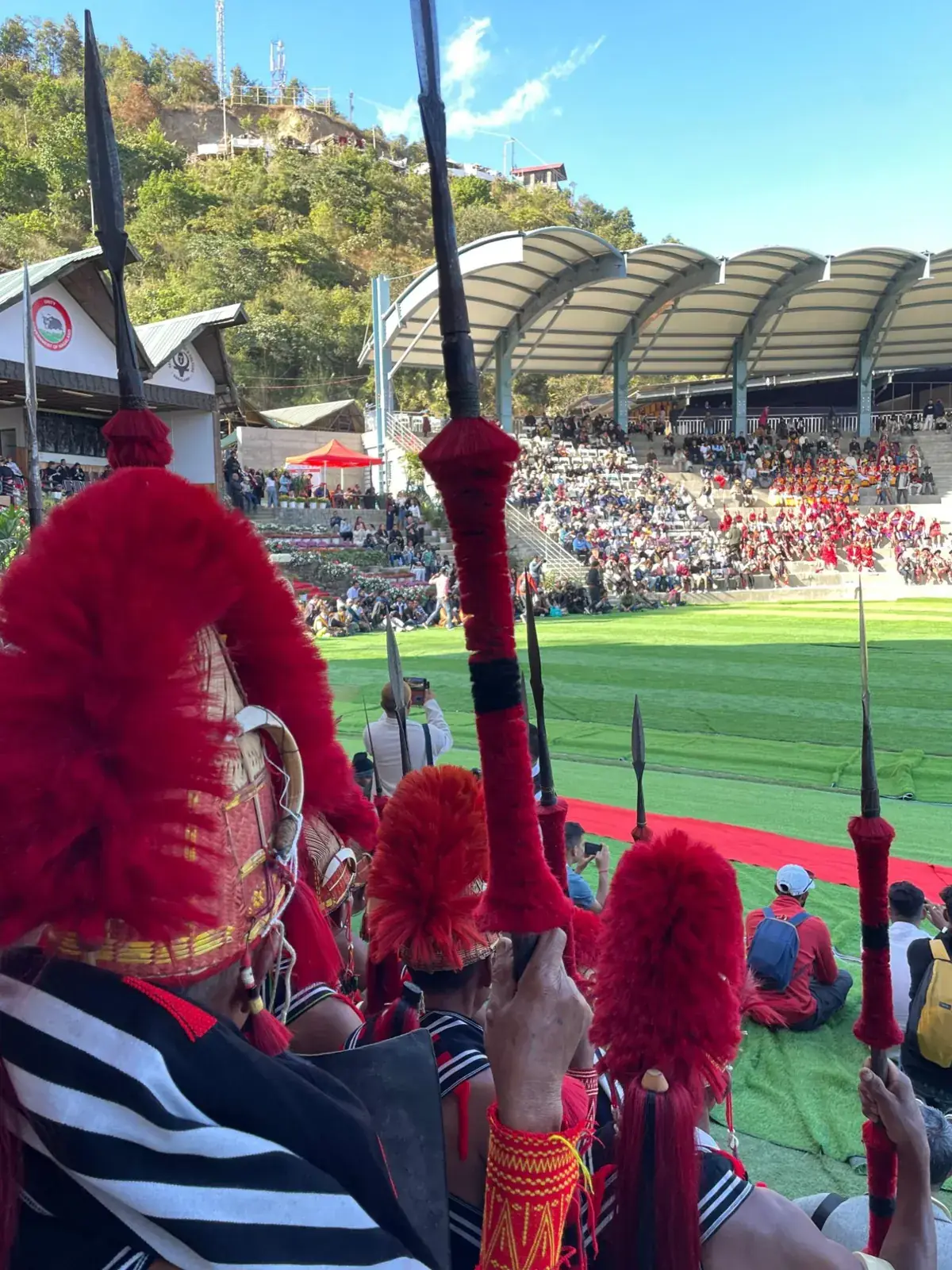
 Group tripFestival5N / 6D
Hornbill Festival & Kaziranga
- Kaziranga 1N · Dimapur 1N · Kigwema 3N
- 28 Nov – 3 Dec 2026 · from Guwahati
₹29,999per person

Sixteen Tribes, One Unbroken Culture
From₹18,999per person
Every trip shows its route, nights and price before you message us
Group tripFestival5N / 6D₹29,999per person
 Group tripFestival3N / 4DPrivate tripCulture & villages4N / 5D
Your own Nagaland route
We plan it for you
Tell us the days and who's coming; we send a written plan and price.
Private trip prices are per person for 2. Group trip prices are per seat on fixed dates.
| Trip | Type | Length | For 2 | For 4 | For 6 |
|---|---|---|---|---|---|
| Hornbill Festival & Kaziranga | Group · 28 Nov – 3 Dec 2026 | 5N / 6D | ₹29,999 per seat | ||
| Hornbill Festival from Dimapur | Group · 1 Dec – 4 Dec 2026 | 3N / 4D | ₹18,999 per seat | ||
| Nagaland Tribal Experience | Private | 4N / 5D | ₹32,000 | ₹24,000 | ₹19,500 |
Per person for private trips. Private prices include your stays, daily breakfast, your own car and driver, fuel, tolls and parking; entry fees and other meals are extra.
Best Good Avoid
December for the Hornbill Festival. October–November for Dzükou Valley trekking and uncrowded village visits.
Winter · Dec – Feb (best)
Hornbill Festival in December draws visitors. After the festival, Nagaland is quiet and cool, perfect for village visits. January–February can be cold at higher altitudes.
Spring · Mar – May (good)
Rhododendrons bloom in Dzükou Valley. Weather is pleasant. Villages are active with agricultural work, a good time to see daily life without festival crowds.
Monsoon · Jun – Sep (good)
Heavy monsoon. Dzükou Valley wildflowers bloom in July–August and are spectacular, but trails can be slippery. Village visits are still possible.
Autumn · Oct – Nov (best)
Clear skies, comfortable temperatures. Dzükou Valley trekking is at its best. Villages are harvesting. The quietest and most authentic window before the festival season.
01
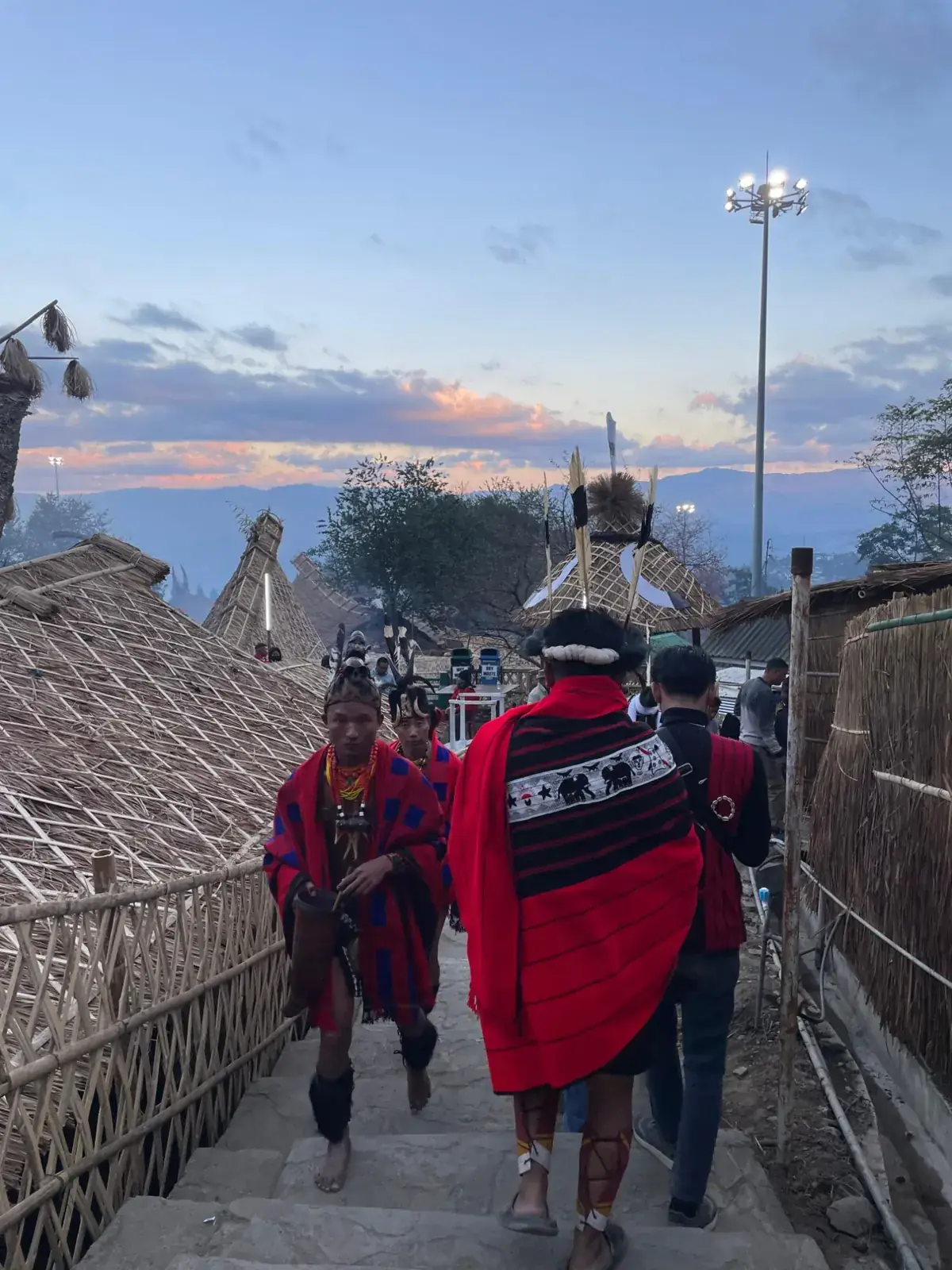
December 1–10: the Kisama Heritage Village fills with representatives of all 16 Naga tribes. Each has its own pavilion displaying food, crafts, and dress. The evening performances (warriors in full traditional regalia, enormous log drums) are unlike anything staged elsewhere in India.
02
The cemetery sits on the ridge where the Battle of Kohima was decided in 1944. Each headstone carries a name, a regiment, and an age. Most are 19–24. The memorial reads: 'When you go home, tell them of us and say: for your tomorrow, we gave our today.' The view of Kohima below makes it harder to leave.
03
India's first green village was founded on the principles of conservation. The villagers voluntarily stopped hunting in the 1990s to protect the Blyth's Tragopan, one of the world's rarest pheasants. Walking through Khonoma with a village elder means understanding Naga history through the landscape itself.
04
A full-day trek from Viswema village drops into the Dzükou Valley, a high-altitude bowl at 2,452 metres that fills with wildflowers in July and empties completely by October: no village, no road, no sound except wind and the occasional bird call from somewhere on the ridge. Overnight camping is possible and recommended.
05
Longwa village straddles the India-Myanmar border. The chief's house is literally on the border: his bedroom is in India and his living room is in Myanmar. The Konyak tribe here still has living elders who remember the headhunting era. Their tattoos tell the history.
06
Naga food is smoked, fermented, and intense. Smoked pork with fermented bamboo shoot. Black sesame chutney. Fresh river fish wrapped in banana leaf. A meal with a Naga family in their kitchen, cooked over wood fire, is the most honest cultural exchange possible.
Nagaland is the least-visited and most misunderstood state in Northeast India. For most of the 20th century it was closed to outsiders: an insurgency, a conflict, a border nobody crossed without permission. What emerged from that isolation is 16 distinct Naga tribes with 16 distinct languages, customs, and warrior traditions, living in villages that have existed for over a thousand years. The isolation preserved them.
Kohima is the gateway, and it carries history heavily. The Battle of Kohima in 1944 was one of the pivotal battles of the Second World War, fought in the tennis court of the Deputy Commissioner's bungalow against a Japanese advance that nearly reached India's eastern plains. The war cemetery above the city is among the most moving memorials in Asia.
The Hornbill Festival, held in December, is the most concentrated cultural event in the Northeast. All 16 Naga tribes gather at the Kisama Heritage Village for ten days of traditional music, dance, cuisine, and ceremony. The tribes are not performing for visitors. They are celebrating for themselves. You are a witness.
Outside the festival season, the real discovery is the villages. Khonoma, the first green village in India, sits in the hills above Kohima and was built around a peace treaty in 1879. Walking through it with a local guide means walking through a living history of Naga resistance, negotiation, and survival.
The Hornbill Festival runs every year from the 1st to the 10th of December at Kisama Heritage Village near Kohima. Often called the festival of festivals, it brings together all of Nagaland's major tribes for ten days of traditional dance, music, food, and craft. It is the single best time to experience Naga culture in one place, and demand for accommodation is intense, so we book months ahead.
Yes. Indian nationals require an Inner Line Permit to enter Nagaland. ClearEast Trip arranges your ILP in advance, you simply provide ID documents. The permit is checked on arrival, so it must be secured before you travel rather than on the spot. Our journeys include the permit as standard, so you never have to navigate the paperwork yourself.
October to May is the best general window for a Nagaland trip, with dry, pleasant weather across the hills. December is dominated by the Hornbill Festival, but visiting in October, November, or the spring months means quieter villages, authentic everyday tribal life, and easier access to remote areas like the Konyak headhunter villages of Mon district, which many travellers find more intimate than the festival crowds.
For the Hornbill Festival, plan four to five nights around Kohima to experience the festival fully alongside nearby villages. To venture deeper, including the former headhunting Konyak villages of Mon, add several more days, as the roads are slow and the distances real. A week lets you experience both the festival and the living tribal culture beyond it without rushing.
A Nagaland journey is priced per person and depends on group size, season, and whether it coincides with the Hornbill Festival, when accommodation is at a premium. Our pricing includes the Inner Line Permit, accommodation, daily breakfast, transfers, local guides, and cultural access. Send us your dates on WhatsApp, especially early for December, and we will share a clear, all-inclusive quote.
Reviews on Google · Read them all →
★★★★★
“Spoke with ClearEast trip team. It was just wow, they are best if anyone planning for bhutan or northeast trip. They don't try to sale. They have guide me step by step and made me understand the complete process for bhutan trip. They hear me out…”
suraj s · Bhutan trip · Google review, Nov 2025
★★★★★
“I booked my Sikkim trip with Cleareast Trip, and it was one of the best travel experiences I’ve ever had! The entire tour was perfectly planned — right from Gangtok to Tsomgo Lake and Nathula Pass. The hotels were clean and comfortable.”
Soniya Mangar · Sikkim trip · Google review, Aug 2025
★★★★★
“I recently booked trip through this travel company and everything was perfectly organised from start to finish. The team was helpful responsive and genuinely cared about making our journey smooth and memorable. Hotels transportation and everything…”
Dipankar Deka · Google review, Aug 2025
Most trips start with a ten-minute chat. Tell us where, when and who's coming, and we reply within a few hours.