Slow Travel vs Fast Travel: What You Actually Miss in Northeast India
The case is not philosophical. It is logistical. Here is what happens when you have ten days instead of five.
You can do Sikkim in four days. You can do it in eight. The difference is not more of the same thing. It is a completely different trip. Here is what actually changes.
The standard case for slow travel is philosophical: you see more, you connect more deeply, you return changed. That case is also correct. But there is a simpler argument that does not require any philosophy, and it is this: in Northeast India, the good things take time to reach, and rushing them makes them significantly worse.
The Kaziranga Problem
Kaziranga National Park holds roughly two-thirds of the world's one-horned rhinoceros population. A four-hour drive from Guwahati on NH37 gets you there. One morning safari, one afternoon safari, and you have technically been to Kaziranga. You will see rhinos. You will go home.
Three safaris is a different experience. The first morning you are oriented: what you're looking at, how the tracker reads the landscape, the scale of the elephant grass. By the second morning, you start seeing differently. The rhino that was impressive on day one is now part of a pattern. On day three, you know the animals by position; the tracker is no longer explaining but sharing. This is not the same trip with more rhinos. It is a different quality of attention, and you can only reach it by staying.
The Zuluk Calculation
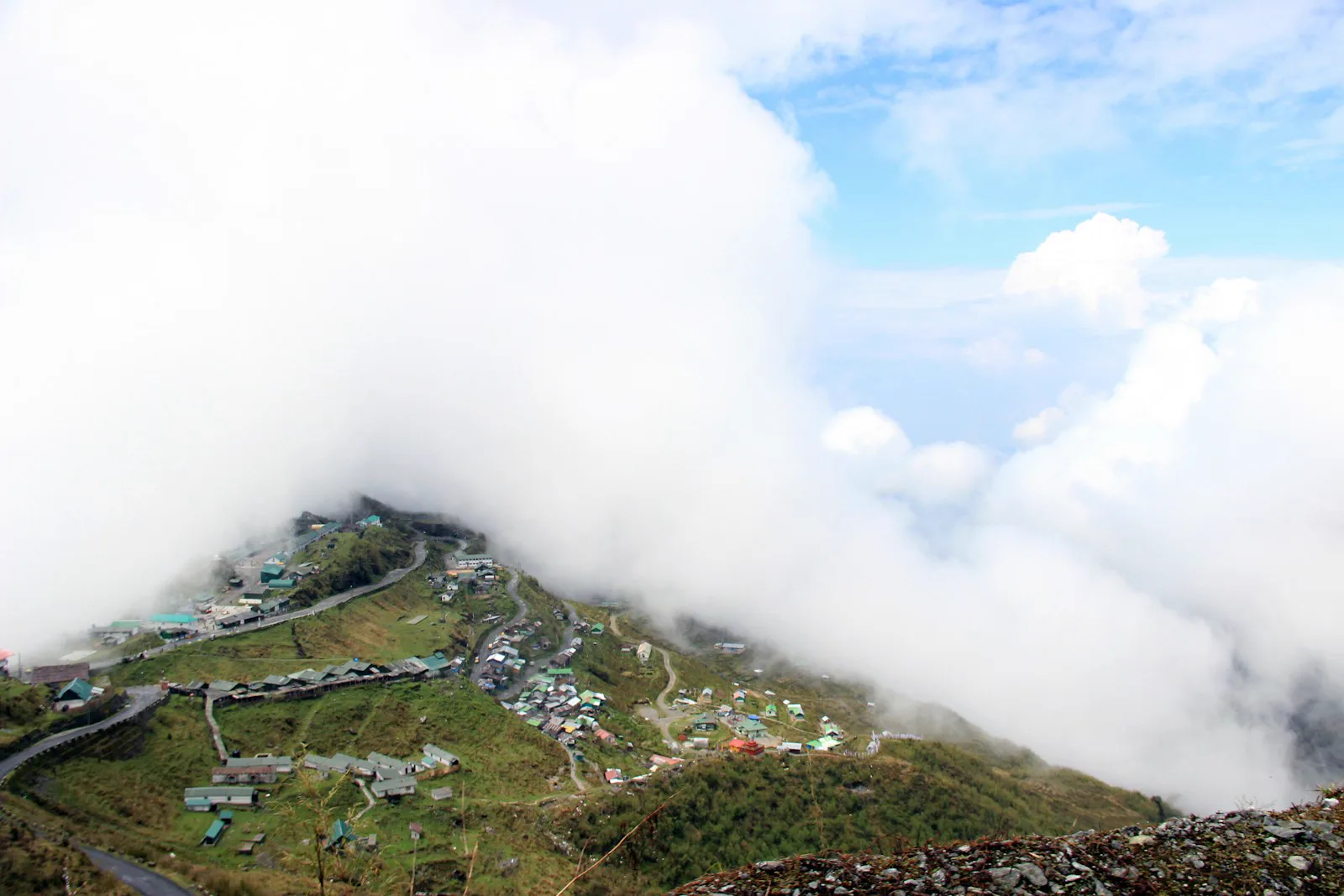
Zuluk on the Old Silk Route in East Sikkim sits at about 9,400 feet. The road above it, visible from Thambi View Point at 11,200 feet, has 32 hairpin bends you can see at once from the right elevation. Nathang Valley, higher up, is high-altitude grassland where the road can have snow from November.
Most people do the Silk Route circuit in one long day from Gangtok: drive out, see Thambi, come back. The circuit, done properly, takes three to four days: Gangtok to Rongli, then up to Zuluk, Nathang, then return via a different route. The first day is the drive. The second morning, before anyone else arrives, you have Thambi View Point to yourself at dawn with the Kanchenjunga range emerging from cloud. That is the thing. You cannot get that on a day trip because the dawn requires a night in Zuluk, and the night in Zuluk requires an SUV and willingness to sleep somewhere basic.
The Root Bridge Equation
The double-decker root bridge at Nongriat in Meghalaya takes about three hours to reach from Tyrna village. You walk down approximately 3,500 steps into a gorge. The bridge is somewhere between 200 and 400 years old, still growing. Most visitors do it in a day: drive to Tyrna, walk down, see the bridge, walk up, drive back to Shillong or Cherrapunji.
If you stay the night in Nongriat (there are basic homestays in the village), the morning is yours. The gorge at 6am, before day-trippers arrive, is a different place. The river is running, the roots are in morning light, you are the only people there. This requires one additional day. What it gives you is the experience that the day-trip version promises but cannot actually deliver.
What Changes at High Altitude
Gurudongmar Lake in North Sikkim sits at 17,800 feet, one of the highest lakes on earth. You need to acclimatise in Lachen (9,000 feet) for a night before going up. You cannot skip this. Any trip that includes Gurudongmar must include two nights in North Sikkim before the lake visit. This is not slow travel as a philosophy. It is altitude physiology. The itinerary is dictated by the mountain.
What happens when people try to rush high-altitude destinations is not that they have a lesser experience. They have a bad one: altitude sickness, headaches, nausea, a day spent in bed in Gangtok recovering. The Himalaya has its own schedule and does not negotiate.
How We Plan Trips
When we build an itinerary, we start with the non-negotiables: the acclimatisation night before Gurudongmar, the two days at Kisama for Hornbill, the night in Zuluk for the dawn. Everything else fits around those. The result is usually a minimum of eight days for Sikkim, ten for a Meghalaya circuit, twelve for a combination.
We do not extend itineraries to sell more nights. We extend them because we have watched people rush these places and miss the thing that made the trip worth taking. The question is not 'how much can I see in five days?' It is 'what do I actually want to experience, and how much time does that require?'
“We almost did the four-day version. I am so glad we didn't.”
— ClearEast traveller, November 2024
Common Questions
How many safaris does Kaziranga actually need?
One safari technically shows you the park. Three safaris change the experience: by the second morning you start seeing differently, and by the third, you know the animals by position rather than being guided to them.
Why does the Zuluk Silk Route need an overnight stay rather than a day trip?
Most people do the circuit as a single long day from Gangtok, driving out to Thambi View Point and back. Done properly it takes three to four days, because the best moment, having Thambi View Point to yourself at dawn with Kanchenjunga emerging from cloud, requires a night in Zuluk first.
Why do you need two nights before visiting Gurudongmar Lake?
Gurudongmar sits at 17,800 feet, and you need to acclimatise in Lachen at 9,000 feet for a night before going up. This isn't a slow-travel preference, it's altitude physiology: rushing it risks altitude sickness rather than just a lesser experience.
How long should a Sikkim or Meghalaya trip be?
We plan around the non-negotiables first: the acclimatisation night before Gurudongmar, the night in Zuluk for the dawn view. The result is usually a minimum of eight days for Sikkim, ten for a Meghalaya circuit, twelve for a combination.
Published
June 29, 2026
Most journeys begin with a
10-minute conversation.
Tell us where you want to go, when, and who is coming. We handle everything from there.
Start the Conversation →ClearEast Trip
Typically replies within a few hours