Northeast India Travel Guide: Which State to Visit First
Stop asking which of the eight sisters. Start asking what kind of traveler you are.
Northeast India is eight states, eight distinct cultures, and hundreds of landscapes. You have ten days. The honest answer to which one first depends not on rankings, but on what you actually want to feel at the end of it.
The question everyone who plans a Northeast India trip asks is the same. Eight states, dozens of landscapes, hundreds of tribes — and you have ten days. Which one first? The honest answer is not a ranking. It depends on what kind of traveler you are, what you want to feel at the end of it, and how much planning complexity you are willing to take on. Here is how we think about it after running trips through this region for years.
If Wildlife Is the Reason You Are Here: Start With Assam
Kaziranga National Park holds roughly two-thirds of the world's remaining one-horned rhinoceros population. That number alone makes Assam worth the flight. The park sits about four hours from Guwahati on NH37, and jeep safaris run at dawn into a landscape of elephant grass and open flood plain where rhinos, elephants, and gaur move with an indifference to vehicles that takes some getting used to. November slots fill weeks in advance, so this is not a state where you can book last minute in peak season.
Assam also works well as a first state because the logistics are simple. Fly into Guwahati (GAU), which has direct connections from Delhi, Kolkata, and Bengaluru. No permits required for Indian nationals. No complicated route decisions for a first trip. Majuli, the world's largest river island, adds a second dimension if you have time: reach it by ferry from Nimati Ghat near Jorhat, and spend a night in one of the Vaishnavite satras (monasteries) where Bhaona performances have been happening for centuries.
If Mountains and Monasteries Are What You Are After: Sikkim
Sikkim is the most accessible high-altitude experience in the Northeast. Indian nationals need no Inner Line Permit for most of the state (North Sikkim and specific high-altitude sites require a Protected Area Permit, arranged through a registered operator). Gangtok is a comfortable base. The roads to Tsomgo Lake and Yumthang Valley are well-established, and the state has a tourist infrastructure that lets a first-time visitor feel oriented quickly.
What Sikkim has that nowhere else does at this distance from Bagdogra: real Himalayan altitude. Gurudongmar Lake sits at 17,800 feet. Yumthang Valley is wide-open alpine grassland at nearly 12,000 feet. And the Buddhist monastery culture here is active, not preserved. The monasteries in Yuksom and Pelling are places where people actually practice, and the oldest monastery in the state, Dubdi, was built in 1701. If you want mountains, cold mornings, and genuine Himalayan scale, this is where to go first.
If Dramatic Landscapes and Discovery: Meghalaya
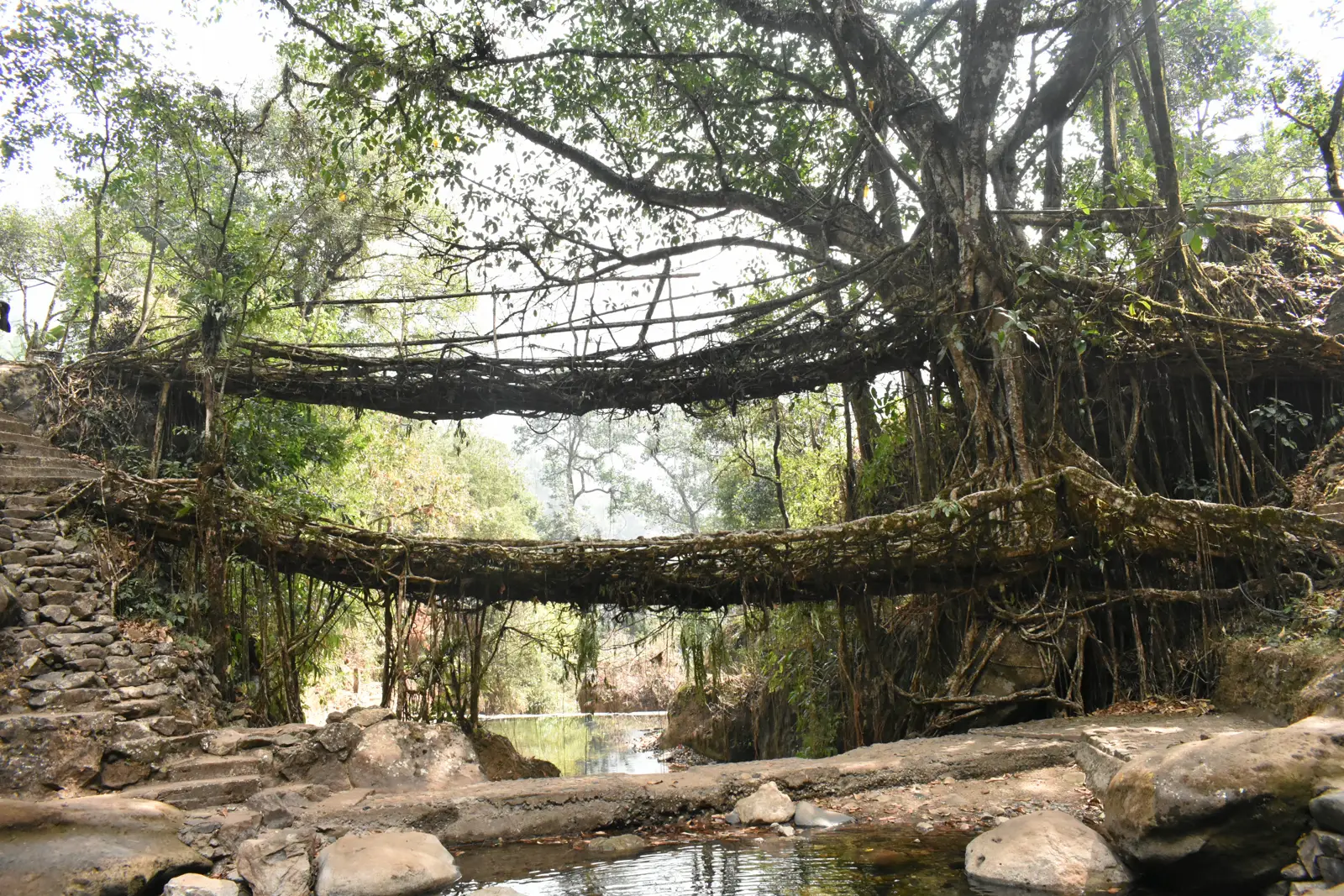
Meghalaya is the state that does not fit any category. The living root bridges of Nongriat — grown from Ficus elastica trees over 200 to 400 years — are among the most extraordinary things in India. The Umngot River at Dawki is so clear that boats appear to float on air, best in winter (November to February) when the monsoon has cleared. Nohkalikai Falls at Cherrapunji drops 340 metres into a jade pool, the highest plunge waterfall in India. Shillong has good coffee, live music on weekends, and the Don Bosco Museum, which is one of the best ethnographic museums in the country.
No permits required for Indian nationals. Fly into Guwahati and drive to Shillong in three hours on NH6, with a stop at Umiam Lake on the way. Meghalaya rewards slow travel: the more time you spend on foot, the more the state gives back. A minimum of five nights lets you cover Shillong, Cherrapunji, and Dawki without rushing.
If You Want Something Most Indian Travelers Have Not Done: Nagaland or Arunachal Pradesh
Nagaland requires an Inner Line Permit but the Hornbill Festival (December 1 to 10, Kisama Heritage Village near Kohima) is the best single cultural event in the Northeast. Sixteen Naga tribes perform, demonstrate craft, and compete in the same space for ten days. Outside the festival, Nagaland is quieter and more demanding: Khonoma, India's first green village, is 20 kilometres from Kohima, and the Dzükou Valley trek from Viswema is one of the finest walks in the region. Accommodation books out early for December, so planning four to six months ahead is not excessive.
Arunachal Pradesh is in its own category. It is the largest state in the Northeast and the least visited by Indian tourists. Tawang is a two-day drive from Guwahati, crossing the Sela Pass at 13,700 feet. Tawang Monastery is the largest in India and the second largest in the world. Ziro Valley, home of the Apatani tribe, is on UNESCO's tentative World Heritage list for its paddy-cum-fish cultivation system. Both require an Inner Line Permit for Indian nationals, applied online through the state's official portal before travel. The permit process is straightforward; the state itself is anything but ordinary.
How Much Time Do You Have?
Five to six days: pick one state. Meghalaya or Assam for first-timers; Sikkim if mountains are the priority. Seven to ten days: combine two. Assam and Meghalaya share a gateway at Guwahati and flow naturally together. Sikkim and Darjeeling is a strong second pairing. Twelve days or more: add Arunachal Pradesh or Nagaland, or go deeper into Sikkim with a North Sikkim extension that includes Gurudongmar and Yumthang.
The common mistake is four states in eight days. You spend most of each day driving, stop briefly at the famous viewpoints, and come home with photos but no memory of any specific morning. One or two states, done at a pace where you stay somewhere two nights in a row and walk somewhere without a schedule, is always better than five states seen from a moving vehicle.
“We almost did Sikkim, Meghalaya, and Assam in ten days. Your team talked us into just Meghalaya and Assam. It was the right call. I still think about that morning at Dawki.”
— A ClearEast traveller, 2025
What We Recommend for First-Timers
We run trips through all of these states and the most common question we get is exactly this one: where do I start, and how do I combine without it feeling rushed? The answer is different for every person. Tell us when you are coming, how many days you have, and what you want to feel at the end of it. We will give you an honest recommendation over WhatsApp before you commit to anything.
Common Questions
Which Northeast Indian state should I visit first?
It depends what you want. Assam if wildlife is the reason, Kaziranga holds roughly two-thirds of the world's one-horned rhinos and has simple logistics via Guwahati. Sikkim for mountains and monasteries at real Himalayan altitude. Meghalaya for dramatic landscapes: living root bridges, the Umngot River, waterfalls. Nagaland or Arunachal Pradesh if you want something few Indian travellers have done.
Do I need a permit to visit these states?
It varies. Assam and Meghalaya need no permits for Indian nationals. Sikkim needs no permit for most of the state, though North Sikkim and specific high-altitude sites require a Protected Area Permit. Nagaland and Arunachal Pradesh both require an Inner Line Permit, applied online in advance.
How many states can I realistically cover in ten days?
One or two, done properly, not four. Five to six days suits one state. Seven to ten days lets you combine two that share a natural gateway, Assam and Meghalaya via Guwahati, or Sikkim and Darjeeling. Twelve or more days makes room for Arunachal Pradesh, Nagaland, or a deeper North Sikkim extension.
What's the most common mistake first-time Northeast India travellers make?
Trying to cover four states in eight days. Most of each day ends up spent driving between famous viewpoints, and the trip comes home with photographs but no memory of any specific morning. One or two states at a slower pace consistently works better.
Published
June 26, 2026
Most journeys begin with a
10-minute conversation.
Tell us where you want to go, when, and who is coming. We handle everything from there.
Start the Conversation →ClearEast Trip
Typically replies within a few hours